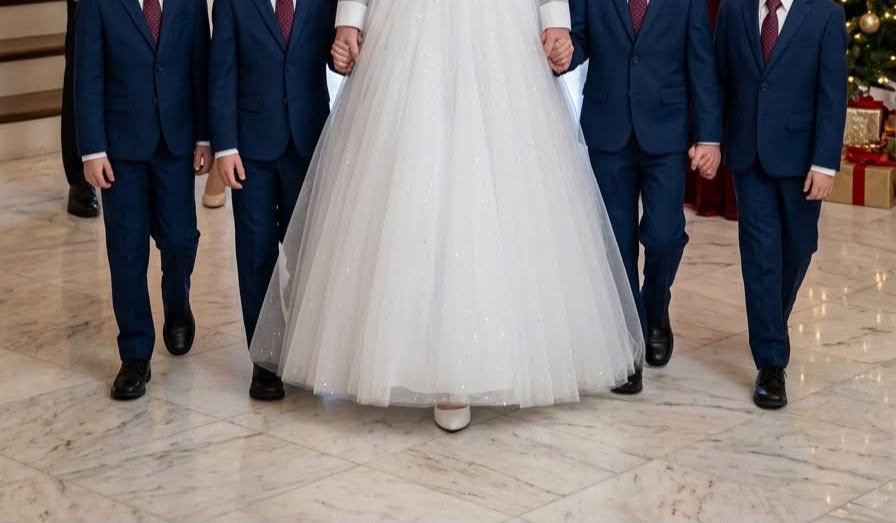
My ex-husband called my pregnancy a lie, walked away, and spent eight years pretending I had invented a child to keep him. So when he invited me to his family’s Christmas dinner, I accepted. He expected me to come alone. But when four little boys crossed that snowy field beside me, he finally saw the truth pride had kept him from asking.
Part 1: The Christmas Invitation
Eight years after my divorce, my ex-husband invited me to Christmas dinner so I could watch him celebrate the perfect life he had built without me. He expected his “childless” ex-wife to arrive alone; instead, just before dinner, a military helicopter descended toward the snowy field beside his family’s Colorado estate.
When the door opened, I stepped out first.
Then four eight-year-old boys climbed down behind me.
The moment Major Nathan Caldwell saw their faces, his smile vanished.
But I am getting ahead of myself.
Three weeks earlier, I was sitting at my kitchen table in Colorado Springs when Nathan’s invitation appeared in my inbox.
The Caldwell Family Christmas Dinner.
The message was polite.
Amelia, my parents are hosting Christmas dinner this year. Since we’ve both moved on, I thought it might be nice to put the past behind us. My fiancée, Claire, will be there, along with the family. You’re welcome to join us. Nathan.
I stared at the screen.
Then I laughed.
Not because it was funny, but because I knew exactly what the invitation meant. Nathan had recently become engaged, and his parents were throwing a formal Christmas dinner to welcome Claire into the family.
He wanted me there as contrast.
Claire was beautiful, accomplished, charming, and apparently everything the Caldwells had ever wanted for him.
And then there was me.
Amelia Brooks.
The woman Nathan had once described during our divorce as someone who could not accept when something was over.
For years, he had let his relatives believe I remained lonely, bitter, and unable to move on. But the worst lie was not about me.
It was about the pregnancy he refused to believe.
Before the divorce was finalized, I told Nathan I was pregnant. He accused me of inventing a baby to make him stay. I offered medical paperwork. He refused to see it. I begged him to attend one appointment. He called it emotional manipulation.
Then came the ultrasound that changed my life.
Not one heartbeat.
Four.
Quadruplets.
I called Nathan.
He did not answer.
His attorney replied instead.
After that, I stopped begging a man to believe the truth.
Months later, four premature but determined boys were born: Oliver, Miles, Theo, and Jonah.
They became my whole world.
And Nathan knew none of it.
Part 2: Four Sons He Never Looked For
I had never hidden my sons because I was ashamed of them, and I had never spent eight years planning some dramatic Christmas revenge.
Life simply moved forward.
When the boys were babies, survival consumed everything. Feeding schedules covered the refrigerator. Medical appointments filled every calendar. Laundry never ended, and sleeping ninety minutes at a time felt like luxury.
My mother moved in for a while. My older brother, Ryan, helped whenever he could. Friends from the hospital brought food, and neighbors folded tiny clothes at my kitchen table.
Slowly, the boys grew.
Oliver became the quiet reader. Miles could take apart almost anything and usually put it back together. Theo was fearless, charming, and responsible for half the gray hairs on my head. Jonah was sensitive, funny, and always noticed sadness before anyone else did.
They looked unmistakably related.
Worse for Nathan, they looked unmistakably like him.
All four had his dark eyes, straight nose, crooked eyebrow, and stubborn expression. My brother once watched Miles press his lips together in irritation and nearly dropped his coffee.
“If Nathan ever needs a DNA test,” Ryan said, “he might be the only man alive who can save the lab fee.”
My sons always knew Nathan’s name. I never lied to them, but I never taught them to hate someone they had never met.
When Oliver saw the invitation on my laptop, he asked, “Does his family know about us?”
That question hurt.
“They know I told him I was pregnant.”
“That’s not what I asked.”
No.
It wasn’t.
I looked toward the living room, where his brothers were building a fortress from every cushion I owned.
“No,” I admitted. “I don’t think they know you were born.”
Oliver absorbed that quietly.
Then he said, “Maybe they should.”
Within minutes, all four boys were gathered around my laptop.
Theo frowned. “So he thinks Mom made up four whole people?”
Jonah corrected him. “Technically, he thinks she made up one.”
“That is not better,” Miles said.
Then Miles asked the question that changed everything.
“Can we go?”
I hesitated. “Why?”
He shrugged. “Because they’re our family too, right?”
That evening, I accepted Nathan’s invitation.
His reply came six minutes later.
Glad to hear it. I think this will be good for everyone.
I smiled.
He had absolutely no idea.
Part 3: The Helicopter in the Snow
The Caldwell estate looked exactly as I remembered it: stone walls, tall windows, dark timber beams, and Christmas lights wrapped around enormous pine trees. Fresh snow covered the ground, and smoke curled from the chimneys into the cold afternoon sky.
Inside, I knew everything would be perfect.
Nathan’s mother, Margaret, believed Christmas should look ready for a magazine photographer at any moment. There would be silver candlesticks, crystal glasses, a twelve-foot tree, and a dinner table large enough for three generations of Caldwells.
At 4:15 p.m., Nathan walked outside with several relatives to greet guests.
Later, Claire told me they had been talking about me.
Apparently, someone asked if I was really coming.
Nathan laughed.
“She said she is.”
“Alone?”
“Who else would she bring?”
Then they heard the helicopter.
At first, no one connected it to the dinner. Colorado Springs had enough military activity that aircraft overhead were normal.
But this helicopter was descending.
Snow lifted in spirals as it approached the authorized landing field beyond the property boundary. Margaret stepped onto the terrace.
“What in the world?”
The aircraft touched down.
A crew member stepped out first.
Then me.
I wore a cream winter coat, dark trousers, and the red scarf Jonah had chosen because he said Christmas required “at least one dramatic color.”
Then Oliver climbed down.
Then Miles.
Then Theo.
Then Jonah.
Four boys.
Four matching dark heads.
Four faces Nathan could not explain away.
For perhaps the first time in his adult life, Major Nathan Caldwell had nothing to say.
He stared at the boys.
Then at me.
Then back at them.
His face went pale.
Margaret lifted one hand to her mouth. Nathan’s father, Richard, whispered one word.
“No.”
I took my sons’ hands.
Together, we walked toward the house.
Part 4: Eight Years of Denial
Nathan met us halfway across the lawn.
“Amelia.”
It came out barely above a breath.
“Merry Christmas, Nathan.”
His eyes moved from one boy to the next.
“Who…”
He could not finish.
Theo whispered loudly to Miles, “This is more awkward than Mom said.”
“Theo.”
“Sorry.”
Nathan stared at me. “Are they…”
“Yes.”
His expression hardened automatically.
“No.”
I had expected shock, anger, maybe regret.
I should have known denial would arrive first.
“No?” I asked.
“This isn’t possible.”
Miles looked at him. “I’m pretty sure we’re possible.”
I placed a hand on his shoulder.
Nathan barely heard him.
“You told me you were pregnant.”
“I did.”
“You said one baby.”
“At the time, I thought it was one.”
His eyes widened. “Four?”
“Quadruplets.”
Margaret and Richard reached us then. Margaret stared at Oliver, then at Nathan, then back at Oliver.
“He looks exactly like you did at that age,” she whispered.
Richard stepped closer to Jonah.
“How old are you?”
“Eight.”
“When is your birthday?”
“August seventeenth.”
Richard turned toward his son. I watched the calculation happen in his face—the divorce, the dates, the pregnancy I had claimed, and Nathan’s certainty.
“Nathan…”
“I need to talk to Amelia privately.”
“No,” Oliver said.
Every adult turned toward him.
My oldest son stepped forward.
“You can talk to her. But if you’re talking about us, we’re staying.”
Something flickered across Nathan’s face.
Recognition, perhaps.
Because Nathan had always hated being excluded from conversations that concerned him.
Apparently, so did his son.
Claire approached quietly from behind the family. She was elegant, composed, and clearly unprepared for any of this.
“Maybe we should go inside,” she said gently. “The boys must be freezing.”
Jonah nodded immediately. “I can’t feel my toes.”
That broke the spell.
Margaret suddenly became a grandmother before anyone had officially given her permission.
“Oh! Of course. Please, come inside. All of you.”
She reached toward Jonah, stopped herself, and looked at me.
That hesitation mattered.
I nodded.
Jonah took her hand.
And Margaret Caldwell’s eyes filled with tears.
Part 5: Dinner With Four Missing Chairs
If you have never watched a formal family dinner reorganize itself around four unexpected eight-year-olds, I recommend it.
Within ten minutes, Margaret’s careful seating plan was useless. Four extra chairs appeared. Additional place settings were brought out. Theo discovered the Christmas crackers beside each plate and started negotiating for everyone else’s.
Miles found Richard’s antique model airplane collection.
Jonah complimented Margaret’s tree.
Oliver stayed close to me.
Nathan sat across from us and barely touched his food. His relatives kept looking from him to the boys.
Finally, Aunt Caroline set down her fork.
“Well, someone needs to say something.”
“Caroline,” Margaret warned.
“What? We have four children at this table nobody knew existed.”
Theo leaned toward Jonah. “I like her.”
I nearly choked on my water.
Caroline looked at me. “Amelia, did Nathan know?”
The room froze.
I answered carefully. “He knew I was pregnant before the divorce was finalized.”
Every eye shifted to Nathan.
Richard spoke first. “You told us she made it up.”
Nathan’s jaw tightened. “I believed she had.”
“You believed?”
“I was told there was a pregnancy after our marriage had already collapsed. Amelia wanted me to come back.”
“That is not what happened,” I said.
Nathan finally looked at me. “You called me repeatedly.”
“To ask you to attend a medical appointment.”
“You knew I was leaving.”
“I knew you had stopped listening.”
The room became painfully quiet.
I could feel my sons absorbing every word.
So I ended it.
“This conversation isn’t helping them.”
I turned to the boys. “Why don’t you check out the game room downstairs?”
Richard stood quickly. “It’s still there.”
Miles brightened. “Does it have foosball?”
“It does.”
“Pool table?”
“Yes.”
“Sir, you have my attention.”
Richard smiled despite himself and led them away. Margaret followed, claiming someone had to show them where she kept the Christmas cookies.
That left Nathan, Claire, and me.
For several seconds, no one spoke.
Then Nathan asked, “Why didn’t you tell me they were born?”
I stared at him.
“I did.”
Part 6: The Letter He Never Read
Nathan’s eyes narrowed. “No, you didn’t.”
“I sent a certified letter to your attorney after they were born. It included their birth records and a request for you to contact me if you wanted to establish paternity formally.”
He looked stunned.
“I never saw it.”
“That may be true. But it was delivered.”
I had kept copies. Not because I planned a confrontation eight years later, but because becoming the single mother of quadruplets teaches you to keep paperwork for everything.
“I also called the number I had for your unit family liaison,” I said. “I was told communication should continue through counsel because the divorce had just been finalized.”
For the first time that evening, the certainty left Nathan’s face.
Claire looked at him.
“You never checked?”
He did not answer.
She repeated it. “Nathan, after Amelia told you she was pregnant, you never checked whether she actually had a baby?”
“I thought…”
He stopped.
There was nowhere for the sentence to go.
Claire finished it for him.
“You thought you couldn’t possibly be wrong.”
That was the moment I started liking her.
Later, I found Nathan alone in his father’s study, surrounded by generations of Caldwell military history: portraits, medals, commendations, and his grandfather’s folded flag.
For the first time, he looked small beneath all of it.
“Amelia.”
“The boys are playing downstairs.”
He nodded. “Oliver beat my father at chess.”
“That sounds like Oliver.”
A faint smile appeared, then vanished.
“Are you sure they’re mine?”
I had known the question would come.
“Yes.”
“I want a DNA test.”
“You’re entitled to ask.”
His eyebrows rose, as if he expected a fight.
“I’m not offended, Nathan. DNA doesn’t frighten me. But understand something. You don’t get to demand proof and assume proof automatically gives you a relationship with them.”
“They’re my sons.”
“Biologically, yes.”
“That means something.”
“It means a great deal. But fatherhood is not a rank someone hands you because you passed a test.”
He looked away.
“They are eight years old,” I continued. “They have memories, fears, routines, favorite foods, and inside jokes. Oliver hates bananas. Miles sleeps with a screwdriver under his pillow because apparently that seems reasonable. Theo pretends he is not afraid of thunderstorms. Jonah cries at movies where dogs get lost.”
Despite everything, Nathan smiled.
Then his eyes filled.
“I have four sons.”
“Yes.”
“I missed everything.”
“Yes.”
That answer hurt him.
But I was done protecting him from the truth.
Part 7: Starting With a First Name
The DNA results came back after New Year’s.
The probability of Nathan’s paternity was greater than 99.99 percent.
No one was surprised.
Except perhaps Nathan, who stared at the report for several minutes before putting it down.
Our first real conversation afterward happened at my house. He arrived without his uniform, medals, or command voice. Just jeans, boots, and a nervous expression.
The boys were in the kitchen making pizza. Theo had flour in his hair. Miles was arguing that pepperoni distribution required mathematical fairness. Jonah was eating cheese straight from the bag.
Oliver noticed Nathan first.
“Hi.”
“Hi.”
An awkward silence followed.
Then Nathan said, “Could I talk to you guys?”
Four boys looked at me.
I nodded.
We moved into the living room. Nathan sat across from them, and for several seconds, the man who could brief senior officers without notes could not find one sentence.
Finally, he said, “I owe you an apology.”
The boys listened.
“Your mom told me about you before you were born. I didn’t believe her.”
Miles frowned. “Why?”
Nathan swallowed. “Because I was angry. And proud. And I thought I understood everything when I didn’t.”
Theo crossed his arms. “That was dumb.”
“Theo,” I said.
Nathan raised a hand. “No. He’s right.”
Theo immediately looked pleased.
Nathan continued. “I missed eight years because of a decision I made. That is not your mom’s fault. And it is not yours.”
Oliver asked, “Do you want to be our dad now?”
There it was.
The hardest question.
Nathan’s eyes filled again.
“Yes.”
Oliver studied him.
“But you don’t know us.”
“No.”
“And we don’t know you.”
“No.”
“So you can’t just suddenly be Dad.”
Nathan nodded slowly. “You’re right.”
The old Nathan would have defended himself.
Explained.
Commanded.
This man did none of those things.
He asked, “Could I start by being Nathan?”
Oliver looked at his brothers.
Miles shrugged.
Theo asked, “Can you throw a football?”
“Yes.”
“How far?”
“Pretty far.”
“Then I vote yes.”
Jonah sighed. “That’s not how voting works.”
“It is now.”
Oliver finally smiled.
“Okay. You can start as Nathan.”
And that was how it began.
Not with instant forgiveness.
Not with a perfect reunion.
With a first name.
Part 8: A New Kind of Family
There was one more person whose life had been overturned that Christmas.
Claire.
A week after the DNA results, she asked to meet me for coffee. I expected discomfort, maybe defensiveness.
Instead, she sat across from me and said, “I need you to know I had no idea.”
“I know.”
“Nathan told me there had been a pregnancy claim during your divorce. He said it wasn’t real.”
“That’s what he believed.”
Claire shook her head. “That’s what he chose to believe.”
Again, I liked her.
I asked the question I had been avoiding.
“Are you still getting married?”
She looked through the window.
“We postponed the wedding.”
“This isn’t because he has children,” she said quickly. “I always wanted a family.”
“Then why?”
“Because I need to know the man I marry can admit when he is wrong before eight years pass.”
That was fair.
Over the next months, Claire did not disappear. She did not compete with me or demand the boys call her anything. She simply showed up when invited.
She learned Oliver loved astronomy. She helped Miles build a model rocket. She taught Theo a card game he became obsessed with. She discovered Jonah loved baking, and together they made enough cupcakes to feed the neighborhood.
Slowly, something unexpected formed.
Not the family any of us would have designed.
But a family nonetheless.
Margaret became the most enthusiastic grandmother in Colorado and tried to recover eight missing Christmases in three months.
The first time she arrived with twenty-seven wrapped gifts, I stopped her at the door.
“Margaret.”
“I missed eight birthdays.”
“You cannot fix that with a department store.”
“I know.”
Then she held up a smaller package.
“These are photo albums. I thought the boys could choose pictures from each year, and I could make four copies.”
That was different.
I let her in.
Richard took the boys fishing. The first trip lasted forty-five minutes because Theo fell into the lake. The second went better.
Nathan’s relationship with the boys grew slowly. There were setbacks. He missed one school performance because duty called, and Oliver barely spoke to him for a week.
Old Nathan would have explained why everyone needed to understand.
New Nathan sat beside Oliver and said, “I know why you’re disappointed.”
Another time, Nathan tried to discipline Miles during a visit.
Miles shouted, “You’re not my real dad!”
The words devastated him.
But he did not leave.
He did not retaliate.
He said, “I understand why it feels that way. I’m still going to care about you.”
Eventually, the boys began calling him Dad.
Not at the same time.
Oliver was last.
Nearly two years after that Christmas, Nathan drove him home from a science competition during a snowstorm. When they reached my driveway, Oliver climbed out, then leaned back through the open door.
“Thanks, Dad.”
Nathan sat in his truck for ten minutes afterward.
I knew because I watched from the window.
Part 9: Four Second Chances
The next Christmas, we returned to the Caldwell estate.
This time, no helicopter was involved.
Theo was deeply disappointed.
“We peaked too early,” he complained.
“We are arriving in a minivan like normal people.”
“Normal people are boring.”
“Get your coat.”
Inside, Margaret had changed the family display in the hallway. The military photographs were still there. The medals remained. The folded flags still rested in polished cases.
But beside them were four new framed photographs.
Oliver holding his science-fair ribbon.
Miles covered in grease beside a small engine he had rebuilt with Richard.
Theo scoring his first soccer goal.
Jonah wearing an apron and holding a ridiculous three-layer cake.
Below them was a new family photo.
All four boys.
Me.
Nathan.
Margaret and Richard.
Even Claire.
Not everyone had the same last name. Not everyone lived under one roof. Nobody pretended the previous eight years had not happened.
But everyone belonged.
Nathan stood beside me in the hallway.
“I’ve wanted to ask you something.”
I glanced at him. “Dangerous beginning.”
He smiled. “Why did you really come last Christmas?”
There had been a time when I might have said I wanted him to know he was wrong.
Maybe part of me had.
But that was not the real reason.
“Oliver asked whether your family knew about them,” I said. “I realized I had spent years believing I was protecting them by keeping them away from people who doubted me. But eventually, they became old enough to decide whether they wanted that door opened.”
“And they did.”
“Yes.”
Nathan looked toward the kitchen, where the boys were helping Margaret decorate cookies.
“I’m glad.”
“So am I.”
He was quiet for a moment.
“Amelia?”
“Yes?”
“I’m sorry.”
He had apologized before, but this one felt different.
No explanation.
No defense.
No request for forgiveness.
Just accountability.
“I know,” I said.
And I did.
Forgiveness did not mean pretending the past was acceptable.
It meant the past no longer controlled the future.
Nathan and I never got back together. That surprises some people when they hear this story, as if a dramatic revelation is supposed to restore a marriage.
But life does not always need to return to what it was.
Sometimes healing means building something entirely new.
Nathan eventually married Claire. I attended the wedding. So did the boys.
Theo nearly dropped the rings. Miles corrected the DJ’s speaker setup. Jonah cried during the vows. Oliver gave Nathan a quiet hug afterward.
And me?
I had already built the life Nathan once assumed I could never create.
A career I loved.
Four sons who filled my home with noise, missing socks, impossible grocery bills, and more joy than I knew one life could hold.
Sometimes I still think about that first Christmas.
The helicopter blades over the snow.
Margaret standing on the terrace with her hand over her mouth.
Nathan staring at four familiar faces and realizing eight years of certainty had collapsed.
People assume my favorite part was seeing him turn pale.
It was not.
My favorite moment came later that night, when Jonah fell asleep against Richard’s shoulder, Miles and Theo played games downstairs, Margaret showed Oliver childhood photos of Nathan, and Nathan stood silently in the doorway watching them.
He looked at me with enormous regret.
But there was something else too.
Gratitude.
Because although he could never recover the eight years he lost, he finally understood the truth pride had kept him from seeing.
Family is not a reputation.
It is not a last name engraved on silver.
It is not a wall of medals or a perfect Christmas table.
Family is who shows up, who listens, who admits when they were wrong, and who stays long enough to rebuild what was damaged.
That Christmas, Nathan thought he had invited his lonely ex-wife to witness the perfect life he created without her.
Instead, four little boys crossed a snow-covered field toward him.
Four sons.
Four second chances.
And one truth he could no longer deny.